
Franklin County Parole vs Probation
Parole and probation can both place a person in Franklin County while MDOC Community Corrections oversees conditions, yet they begin in different ways. Parole is a discretionary release from incarceration after eligibility review. The Mississippi State Parole Board makes that decision. Probation comes from a judge and can replace incarceration or follow a custodial term. Neither status supplies the exact time that a person left the Franklin County jail operation.
Mississippi also uses Earned Release Supervision, intensive supervision, and Interstate Compact supervision. ERS lets an eligible person serve a remaining sentence portion in the community under MDOC authority. Intensive supervision adds close monitoring. The Interstate Compact permits supervision across state lines. These terms should not be collapsed into a single label.
| Status | How it starts | Who controls it | What confirms it |
|---|---|---|---|
| Parole | Board grants conditional release after eligibility | Parole Board decides; MDOC supervises | MDOC Parolees search and Board response |
| Probation | Judge enters a community sentence | Court orders; MDOC supervises | Sentencing order and MDOC confirmation |
| ERS | Eligible sentence reaches an approved release stage | MDOC retains jurisdiction | MDOC record and supervision papers |
| Discharge | Applicable correctional term or supervision ends | Controlling court or correctional agency | Final agency or court record |
- Eligibility
- The point when review may occur, not a promise of release.
- Supervision
- Community-based correctional authority with reporting and other terms.
- Discharge
- The formal end of the applicable correctional status.
- Absconder
- An agency status tied to leaving supervision without authorization, not a label inferred from a failed search.
Verify Franklin County Post-Release Supervision
The strongest check follows the person from the right custody record into the right supervision channel. A Franklin County arrest alone does not mean MDOC has a record. Someone released on local bond may have no state correctional status. By contrast, a person sentenced to MDOC may move from the Inmates search to the Parolees search while living in Franklin County.
- Open the official MDOC search. Choose the Parolees tab for a person believed to be on parole, and use the Inmates tab when state custody or identity is still unclear.
- Search by MDOC ID when known. Otherwise, use the full first and last name, compare candidates, and avoid relying on a name alone.
- Separate a tentative, ERS, or maximum date from an actual status. A calculated date does not establish a physical release or parole grant.
- Check the sentencing order for probation. The court record states the legal basis, while the sheriff’s booking record establishes a local jail departure.
- Ask MDOC which office supervises the individual. Use a reporting instruction or direct MDOC confirmation before visiting any nearby office.
- For an unresolved parole-status question, use the Mississippi State Parole Board contact listed by MDOC and include the MDOC ID.
The official MDOC home page visually separates its Inmates and Parolees searches. The state search source is shown below.
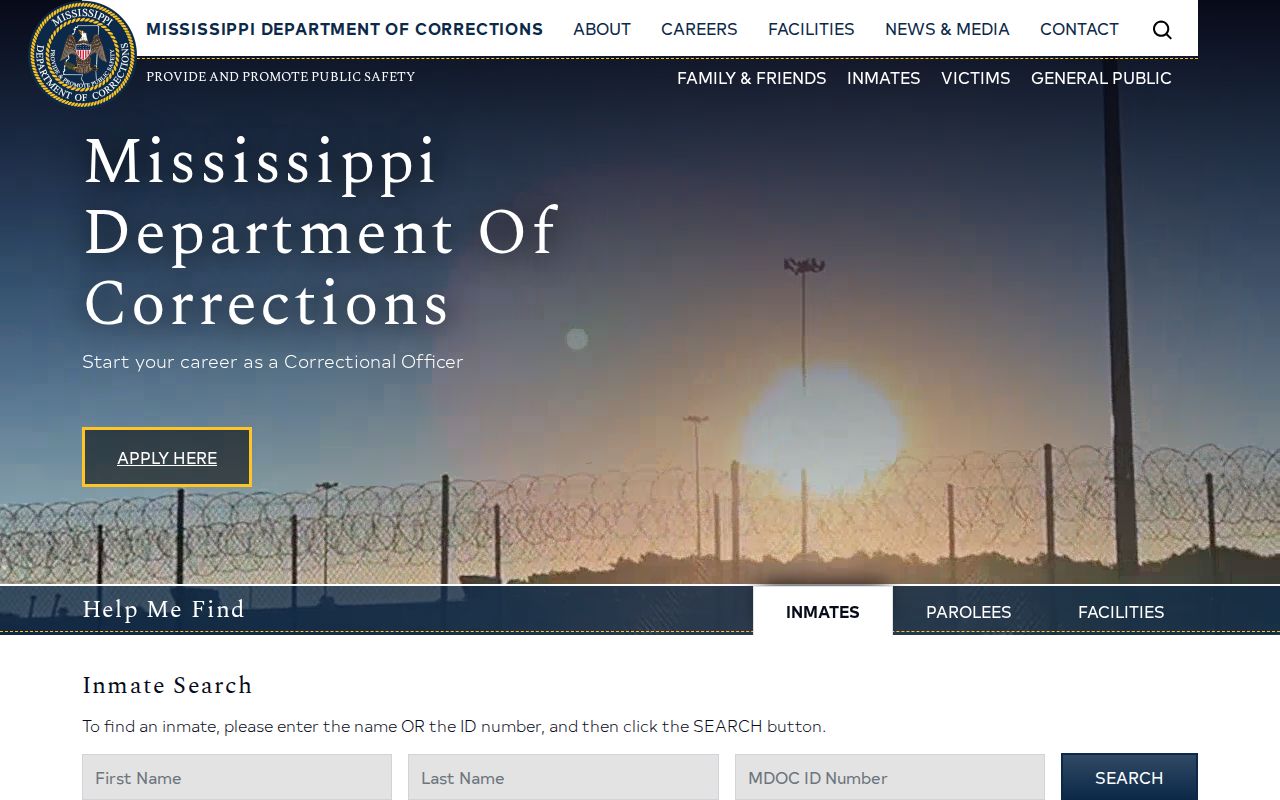
That split helps prevent a local release record from being confused with an active state parole record.
Important: A missing public result does not prove discharge, a violation, or a warrant. Confirm the individual record directly with MDOC.
Franklin County Parole Hearing Status
The Mississippi State Parole Board decides parole, while MDOC Community Corrections handles field supervision after a grant. MDOC says it creates a list of parole-eligible people each month and sends that list to the Board. This describes a monthly administrative workflow. It does not establish a public monthly hearing calendar or a fixed decision date for a Franklin County person.
No official public parole-hearing calendar or decisions database was found in the research sweep. Use the MDOC Inmates search to identify the person and MDOC ID, then review the sentence and any tentative or ERS date as context only. The Parolees tab is the better public channel after the person moves into parole status. If those routes do not settle the question, email MSStateParoleBoard@mdoc.state.ms.us through the officially listed contact route and include the MDOC ID.
A hearing, eligibility review, or favorable response is not the physical release record. Confirm actual departure with MDOC. Likewise, use only the outcome stated in the Board’s authoritative response or order. The reviewed official material did not provide a public glossary of result labels, so generic terms should not be presented as exact Board database values.
Note: MDOC’s monthly eligibility list is an internal workflow, not proof of a public calendar, parole grant, or completed facility release.
Franklin County Supervision Office Check
MDOC publishes a Lincoln Probation and Parole Office in nearby Brookhaven. The reviewed official page does not say that this office serves Franklin County. Its location is therefore a lead for confirmation, not an established Franklin County assignment. The individual’s written reporting instructions or an MDOC response controls.
Call before making a trip. Give the person’s name and MDOC ID, ask whether the office is assigned to that case, and request the correct office if it is not. Do not send supervision reports, documents, or payments to a nearby office solely because it appears geographically convenient.
Lincoln Probation and Parole Office
223 South Railroad Avenue
Brookhaven, MS 39601
601-833-3965
Assignment warning: Franklin County jurisdiction is unconfirmed.
The nearby office listing documents the address and phone shown here.
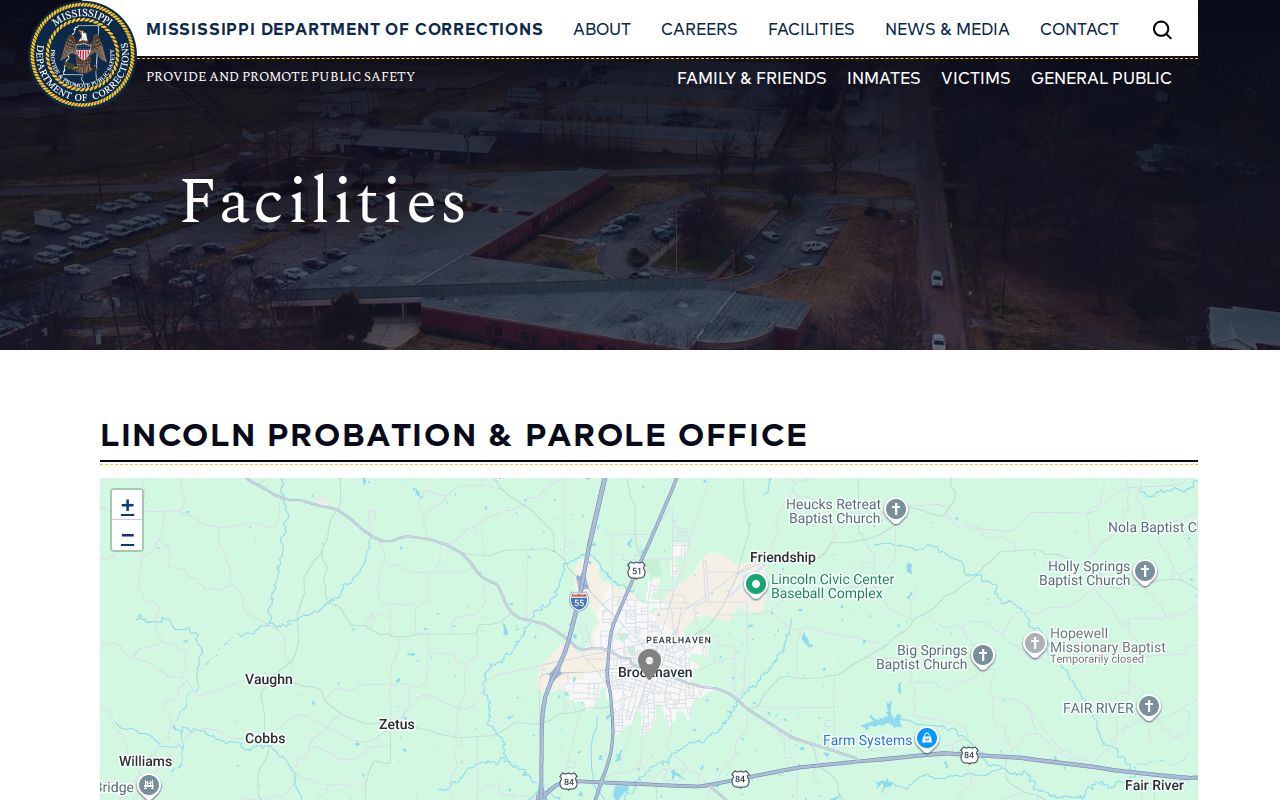
The listing should be paired with a phone check because it does not confirm that Franklin County cases report there.
Note: A nearby address is not proof of assignment; the person’s supervision document or MDOC confirmation identifies the proper reporting office.
Franklin County Supervision Conditions
When probation is granted, MDOC says a probation agent conducts an initial interview and provides the conditions. A parole order, ERS plan, or Interstate Compact document can set a different mix of duties. The exact written terms matter. General labels cannot establish where a person reports, what travel is allowed, or whether a specific act is a violation.
ERS has its own local significance. MDOC reviews institutional behavior and classification, receives a proposed residence, and has an agent inspect and approve the plan. Reaching an ERS date alone does not complete that process. Once the person leaves a facility on ERS, MDOC still has jurisdiction and may act on violations.
Mississippi SAVIN/VINE may send an agency-fed alert for escape or absconding from supervision and for a return to custody. It may also report release, transfer, or temporary movement. Yet Franklin County participation in county-jail coverage was not confirmed from a current official list. An alert should be verified with the reporting office, and silence should never be treated as proof of good standing.
Franklin County Supervision Discharge
Release, eligibility, grant, and discharge mark different points. A parole eligibility date allows review under the rules that apply to the conviction. Miss. Code §47-7-3 contains offense, date, sentence, and history restrictions. Eligibility does not compel the Board to grant parole. A grant does not by itself prove that MDOC completed the physical departure process.
After release, parole, probation, ERS, intensive supervision, or Interstate Compact status may continue. Discharge occurs only when the controlling agency or court formally ends that status. Confirm it through MDOC Records, the Board when parole is involved, or the court order when probation terms are at issue. A current sheriff roster cannot answer that question.
For the county-custody portion, the Franklin County released-inmate search and record path explains how the sheriff departure entry and court file fit beside MDOC supervision records. Those sources should agree on the event each one is responsible for, though they may not use the same date or label.
Note: A person can be out of a facility and still under MDOC authority; only a discharge record establishes that supervision ended.
Franklin County Absconder Verification
No official statewide public absconder or supervision-warrant lookup was located in the Franklin County research. That gap changes the verification route. A person should not be called an absconder because a public MDOC search returns no match, an old result, or an unfamiliar office. Public search visibility can change for many reasons.
Ask MDOC or the assigned supervising office about the current supervision status. If a court or law-enforcement warrant channel is appropriate, verify the exact individual and issuing authority there. A VINE notice can corroborate an agency-fed absconding or return event, but it is not a permanent warrant database. Match the agency, identifier, and event before drawing a conclusion.
Status distinction: A violation allegation, an absconder status, and an issued warrant are related concepts, but they are not interchangeable records.
Correct Franklin County Supervision Records
An error should go first to the office that maintains the disputed field. The Franklin County Sheriff’s Office, led by Sheriff Tom Tindle, says jailers maintain booking information, so it is the first correction channel for a wrong local booking or release entry. No online correction form is published. Identify the booking, name the exact field, state the correction sought, and attach the order or other source that supports it.
A parole, probation, ERS, or MDOC status error belongs with MDOC rather than the sheriff. Use the official Records contact or MDOC GovQA portal, include the MDOC ID, and distinguish a public-display concern from an underlying record correction. A court disposition error should be raised with the clerk holding the case file.
The Mississippi registry has a separate correction route for qualifying registry records. It publishes 601-987-1540 and MSOR@dps.ms.gov and warns that positive identity may require fingerprint comparison. Registry presence is not generic proof of parole, probation, or a recent Franklin County release.
Note: State the disputed field and supporting source; a focused correction request is easier to route than a broad claim that every record is wrong.